

The architecture decision that used to be theoretical is now the most consequential choice IoT product teams face in 2026. Should your device process intelligence locally, at the edge, or offload computation to the cloud?
Get it right, and you ship a product that responds in milliseconds, respects user privacy, and scales without bankrupting your cloud budget. Get it wrong, and you end up with a device that is either too slow, too expensive, or too fragile for production environments.
This guide breaks down the engineering trade-offs between edge AI and cloud AI for IoT products, covers the hybrid architectures that most successful products actually use, and gives you a practical framework for deciding where your inference workload belongs.
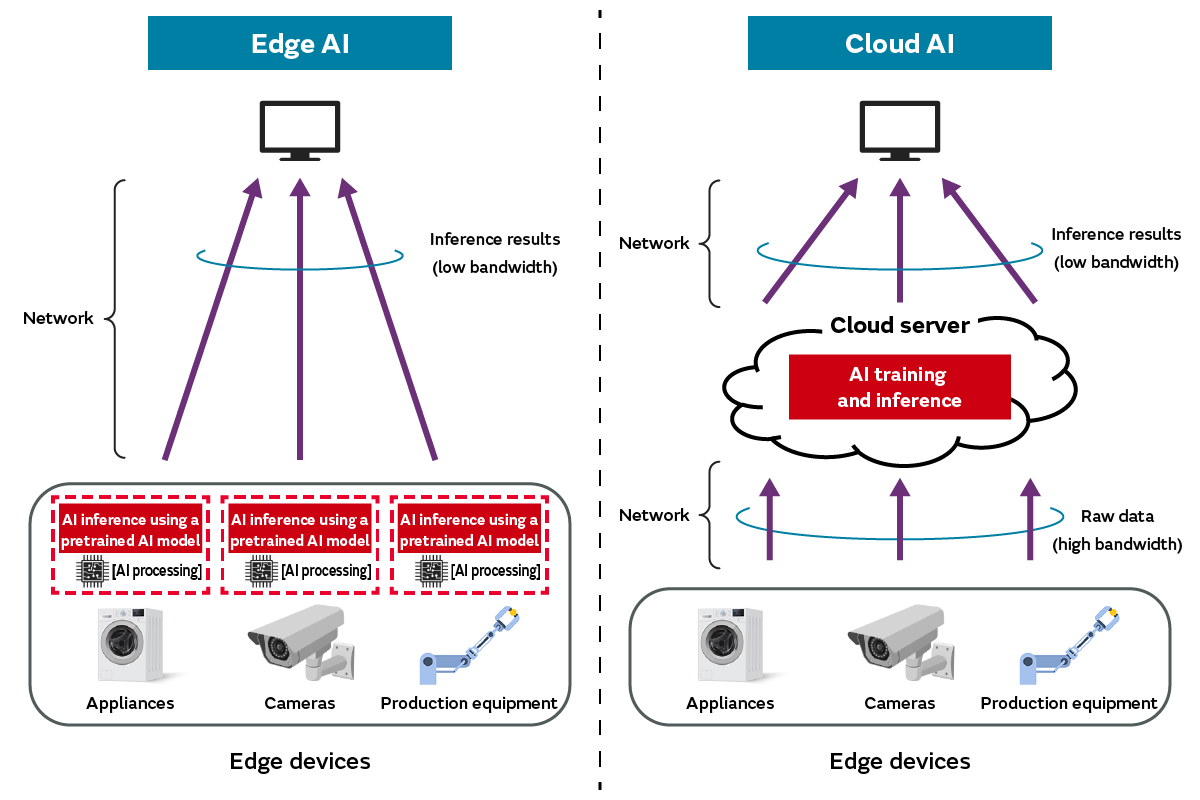
What Edge AI actually means in practice
Edge AI refers to running machine learning inference directly on or near the device that generates data, rather than sending that data to a remote server for processing. In the context of IoT products, this means deploying trained, optimized models onto microcontrollers, embedded processors, or local gateways.
The device collects sensor data, runs inference locally, and acts on the result. Only metadata, anomalies, or aggregated insights travel to the cloud. Not raw data streams.
Common edge AI workloads include:
- Keyword detection on smart speakers
- Anomaly detection on industrial vibration sensors
- Gesture recognition on wearables
- Person detection on security cameras
The inference happens in milliseconds, consumes milliwatts of power, and works regardless of network connectivity.
What makes edge AI particularly relevant right now is the maturity of both the toolchains and the hardware. Frameworks like TensorFlow Lite for Microcontrollers, ONNX Runtime, Edge Impulse, and CMSIS-NN have made it practical to compress, quantize, and deploy models onto Cortex-M class microcontrollers. We are talking about devices with kilobytes of RAM and single-digit dollar price points.
New system-on-chips from Nordic, STMicroelectronics, Ambiq, and Espressif now ship with lightweight neural processing units or DSP extensions designed specifically for on-device inference.
What Cloud AI brings to the table
Cloud AI processes data on centralized servers, typically high-performance GPU clusters hosted by providers like AWS, Azure, or Google Cloud. The device sends raw or lightly preprocessed data over the network, the cloud runs inference or training, and results are returned to the device or a dashboard.
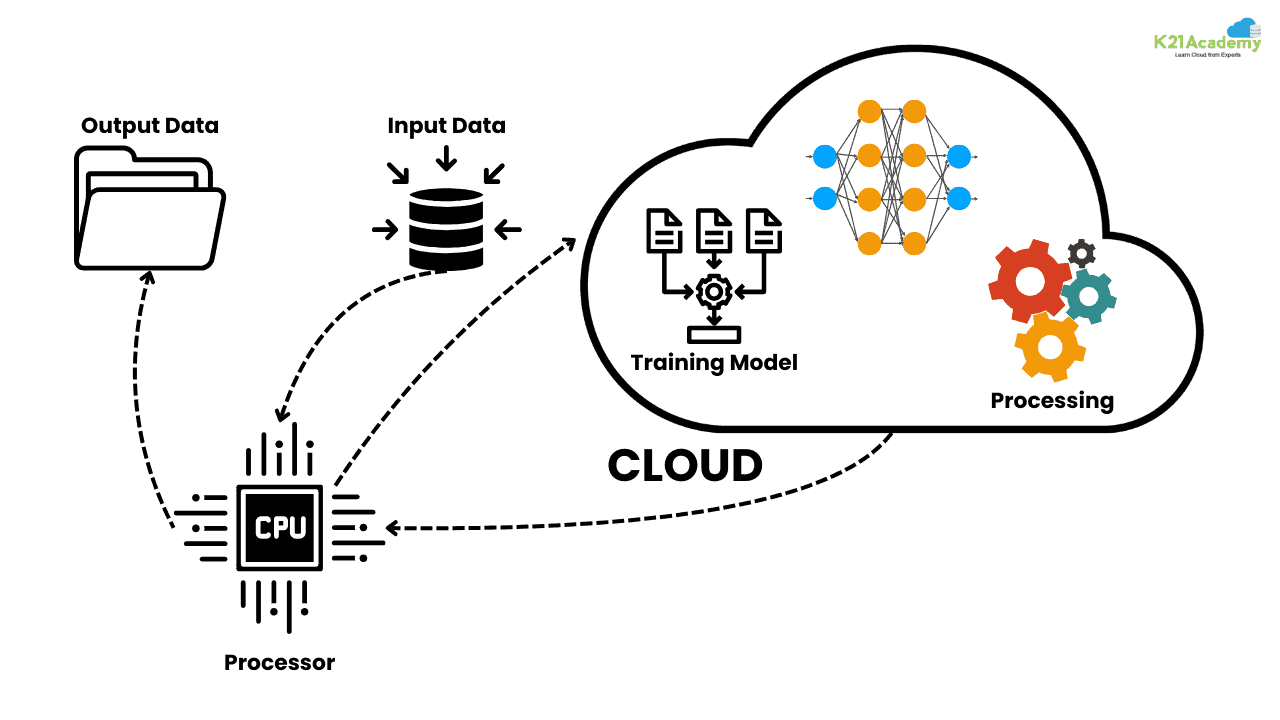
Cloud AI is essential when the workload exceeds what local hardware can handle:
- Training complex deep learning models
- Running large language models
- Performing cross-device analytics
- Aggregating data from thousands of sensors to refine a global model
These are tasks that demand the virtually unlimited compute and storage the cloud provides.
The cloud also simplifies model management. Updating a model is a server-side operation. There is no firmware update, no OTA deployment risk, no device-by-device rollout. For teams shipping their first AI-powered product, this simplicity is often the deciding factor.
But that simplicity comes with trade-offs that become harder to ignore as your fleet grows.
The core trade-offs you need to understand
Choosing between edge and cloud AI is not a simple decision. It is an engineering trade-off across several dimensions, and the optimal balance depends entirely on your specific product requirements.
Latency
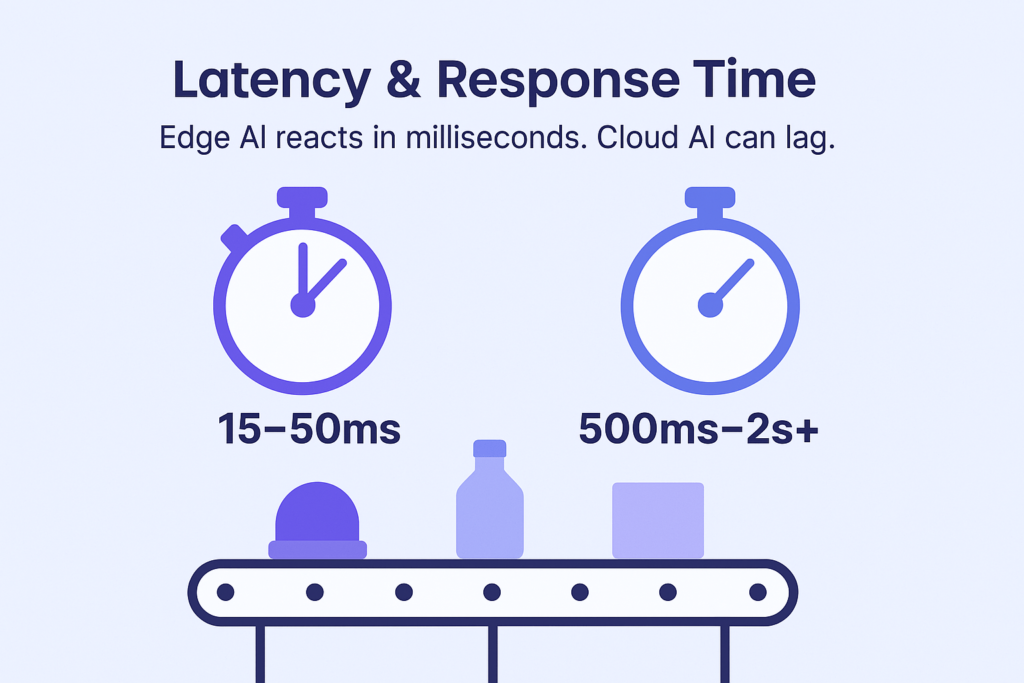
Edge AI processes data locally, typically delivering results in single-digit milliseconds. Cloud AI introduces network round-trip time, anywhere from 500ms on fast broadband to several seconds over constrained cellular or satellite links. For applications where reaction time matters, such as safety shutoffs, autonomous navigation, or real-time audio processing, cloud latency is often simply unacceptable.
Connectivity
Edge AI works offline.
The model is embedded in firmware and runs whether or not the device has internet access. Cloud AI requires a reliable network connection, and if connectivity drops, the device loses its intelligence entirely.
For products deployed in remote locations, underground, or in environments with intermittent connectivity, edge AI provides what engineers call “offline-first reliability.”
Privacy and data sovereignty
Edge AI keeps sensitive data on the device. Sensor streams, audio, video, and health metrics are processed locally and never leave the hardware. This matters enormously in:
- Healthcare, where patient data regulations are strict
- Industrial settings, where process data contains trade secrets
- Consumer products that capture home surveillance footage
- Any deployment subject to GDPR, HIPAA, or data residency rules
Cloud AI requires transmitting data externally, which introduces both compliance complexity and attack surface.
Bandwidth and Operating Cost
Every byte sent to the cloud costs money, especially over cellular networks.
A security camera streaming 24/7 video to a cloud endpoint for analysis generates enormous bandwidth bills.
Edge AI processes locally and sends only results or exceptions, reducing bandwidth consumption by 90% or more in typical deployments.
Over the lifetime of a fleet of thousands of devices, the cost difference becomes significant enough to reshape your entire business case.
Model Updates and Lifecycle Management
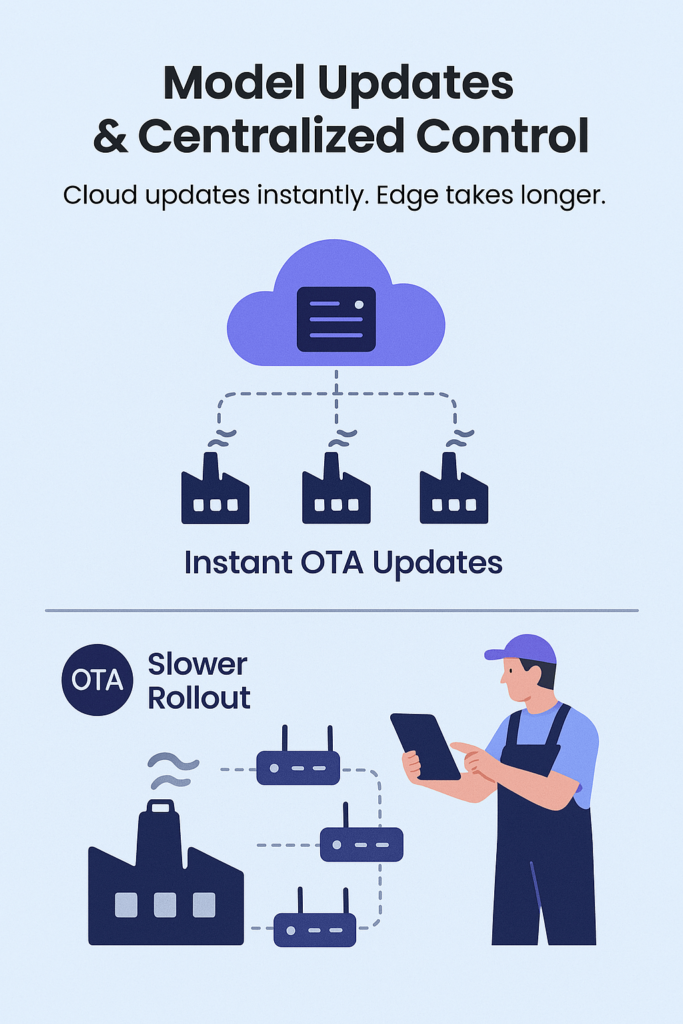
Cloud models are updated server-side with zero device risk.
Edge models require firmware updates, either over-the-air or physically.
Managing model versions across thousands of heterogeneous edge devices requires orchestration infrastructure, rollback mechanisms, and testing pipelines.
This is one of the most underestimated operational costs of edge AI, and one that catches many teams off guard after launch.
Why the real answer is almost always hybrid
In production, most successful IoT products use a hybrid edge-cloud architecture. The edge handles latency-sensitive, privacy-sensitive, and connectivity-critical inference. The cloud handles training, retraining, cross-fleet analytics, and heavy workloads that exceed device capability.
Think of it as a division of labor. The edge reflects, making immediate decisions based on local data. The cloud remembers, aggregating fleet-wide data, retraining models, and pushing improved versions back to devices.
Here is what this looks like in practice:
A predictive maintenance sensor on a factory motor runs a lightweight vibration anomaly detection model on a microcontroller.
The model detects abnormal patterns locally and triggers an alert in real time, regardless of network status.
Periodically, the device sends aggregated failure data and operational metrics to the cloud.
The cloud uses data from hundreds of sensors across multiple factories to retrain and improve the vibration model.
The improved model is then pushed back to devices via OTA update.
TinyML is a subset of edge AI that specifically targets ultra-low-power microcontrollers: Cortex-M4 and M7 class devices, nRF52840 BLE SoCs, and similar hardware.
These are devices with 256KB of RAM or less, running on coin cell batteries for months or years.
An important distinction: TinyML is not about shrinking cloud models to fit on a microcontroller. This requires fundamentally different model architectures, training approaches, and deployment strategies optimized for extreme constraints.
Standard techniques include:
- Quantization: reducing model weights from 32-bit float to 8-bit integer
- Pruning: removing unnecessary neurons to shrink the model
- Knowledge distillation: training a smaller model to mimic a larger one
The ecosystem has matured rapidly.
TensorFlow Lite Micro supports bare-metal deployment. CMSIS-NN provides optimized neural network kernels for ARM Cortex-M processors.
For IoT product teams, TinyML opens up use cases that were previously impossible without cloud connectivity: always-on wake word detection, on-device gesture recognition from IMU data, real-time classification of structured sensor telemetry, and local anomaly detection on industrial equipment.
The market reflects this momentum. The TinyML market is projected to reach over $30 billion in 2026, and roughly 80% of AI inference workloads are expected to run on local devices rather than in the cloud. This shift also makes AI-aware hardware design increasingly important.
A practical decision framework
Rather than debating edge vs. cloud in the abstract, use this framework to evaluate where each component of your AI workload actually belongs.
Run on the Edge when:
- Real-time response is non-negotiable (sub-10ms latency requirements)
- Connectivity is unreliable or unavailable
- Privacy or regulatory compliance demands local processing
- Bandwidth cost drives economics, especially with high-frequency sensor data
- The task is narrow and well-defined (classification, keyword spotting, anomaly detection)
Run in the cloud when:
- The model is too large for device hardware
- Training or retraining is required
- Cross-device or cross-fleet analytics adds value
- Model updates need to be seamless and frequent
- The product can tolerate latency
Use a hybrid architecture when:
- The answer to more than one of the above is “yes” (which is the case for most real-world IoT products)
- You need local inference for immediate decisions and cloud processing for long-term intelligence
- Your fleet scales beyond what a pure edge-only approach can maintain without centralized orchestration
Hardware considerations for Edge AI
Choosing the right hardware platform is foundational. The decision depends on the complexity of the inference workload, power budget, unit cost, and available development tooling.
Best for TinyML workloads like anomaly detection, keyword spotting, and simple classification. ARM Cortex-M4 and M7 devices from STMicroelectronics, Nordic Semiconductor, and Espressif are the most common targets.
- RAM: 64KB to 1MB
- Power: milliwatt range
- Unit cost: $2 to $18
- Battery life: months to years on coin cell
- Toolchain: CubeMX AI, TF Lite Micro
Cost analysis at scale
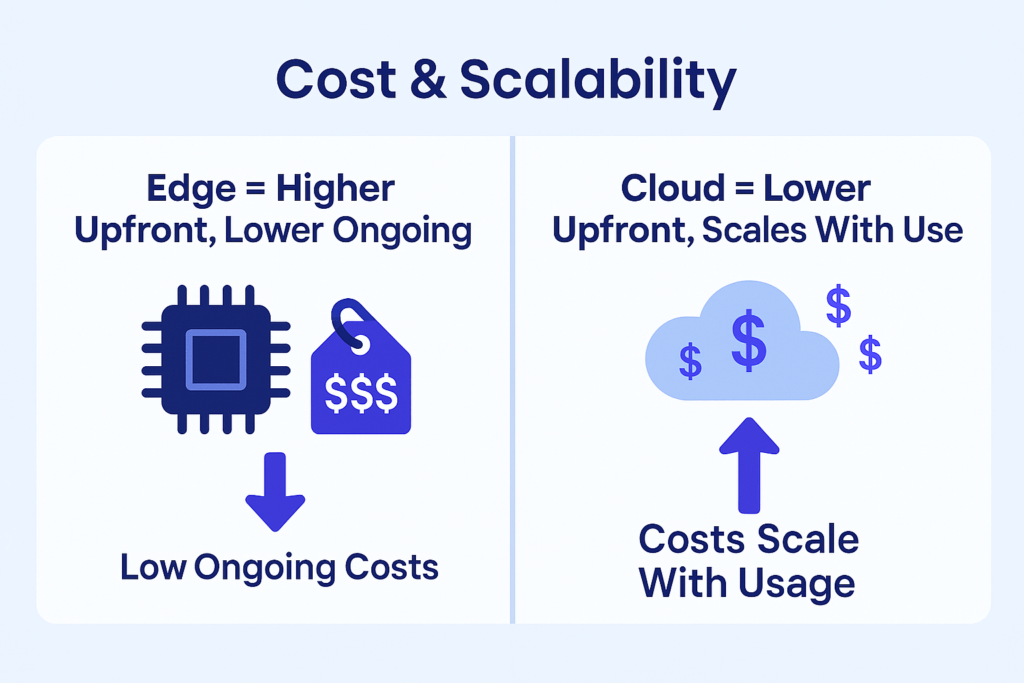
For a single prototype, cloud AI is almost always cheaper and faster to implement. But cost dynamics change dramatically when you start shipping at volume.
Cloud cost example: A device making 100 cloud inference calls per day at $0.001 per call costs $36.50 per year per device. At 10,000 devices, that is $365,000 per year in inference costs alone, before accounting for data transfer, storage, and network fees.
Edge cost example: An MCU with AI acceleration may cost $3 to $5 more per unit than a basic controller. For 10,000 devices, that is a one-time $30,000 to $50,000 increase in bill of materials, with zero recurring inference cost.
The crossover point, where edge hardware investment pays back against cloud operating cost, typically arrives within 12 to 18 months for high-frequency inference workloads.
Neither approach is cost-free. Edge AI requires investment in model optimization expertise, OTA infrastructure, and edge-specific testing. Cloud AI requires investment in reliable connectivity, API management, and scaling infrastructure. The question is which cost structure fits your business model and product roadmap.
What is driving this change in 2026
Several converging trends make this decision more urgent than in previous years:
- Hardware entering the mass market. IoT Analytics has identified 2026 as the inflection point where OEMs move from early pilots to broad portfolio refreshes with edge AI-enabled devices. New SoCs with integrated NPUs are shipping from every major semiconductor vendor.
- Cloud costs under pressure. The global memory shortage, driven by AI data center demand consuming unprecedented shares of DRAM, is pushing service costs higher. This further favors local processing.
- Regulation tightening. The EU Cyber Resilience Act (mandatory in 2027) imposes stricter cybersecurity design and lifecycle maintenance requirements on connected products. Local processing reduces the compliance surface.
- Production-ready toolchains. Model compression, quantization, and deployment frameworks have matured from research tools to production-grade infrastructure. The barrier to entry has dropped significantly.
Where to begin?
If you are designing an IoT product and evaluating AI architecture, here is where to begin:
- Define the inference workload precisely. What data goes in? What prediction comes out? What latency is acceptable? What accuracy is required?
- Profile the hardware constraints. What is your RAM budget? Flash budget? Power envelope? Unit cost target?
- Start with the simplest viable architecture. If the workload is narrow and well-defined, prototype on-device inference first. If it requires heavy computation, start with cloud and evaluate what can migrate to the edge over time.
- Plan for hybrid from day one. Even if your first version is pure cloud or pure edge, architect the firmware and data pipeline to support both. The product requirements will evolve.
- Invest in OTA infrastructure early. If any intelligence runs on the device, you will need to update it. Building OTA capability after launch is significantly harder than designing it from the start.
- Test under real-world conditions. Lab accuracy does not equal field accuracy. Validate models against production sensor data, environmental noise, and manufacturing variance before you scale.
Final thoughts
This is about understanding what runs where, and why. The most resilient, cost-effective, and performant IoT products in 2026 use hybrid architectures that place latency-critical and privacy-sensitive inference at the edge while leveraging the cloud for training, analytics, and fleet-wide intelligence.
Start with the product requirements, profile the hardware constraints and design the architecture around the workload.
Detus helps engineering teams design and ship embedded products with AI capabilities, from hardware selection and firmware architecture to model deployment and production validation. If your product roadmap includes edge AI, let’s talk about your project.