

Executive summary
Long-lived electronic products are frequently designed around semiconductor components whose commercial, manufacturing and supply-chain lifecycles are governed by rules that differ substantially between vendors. A headline such as “10-year longevity” can describe a formal minimum availability program, a planned availability horizon, a portfolio policy, or a typical historical lifecycle. These claims are not equivalent.
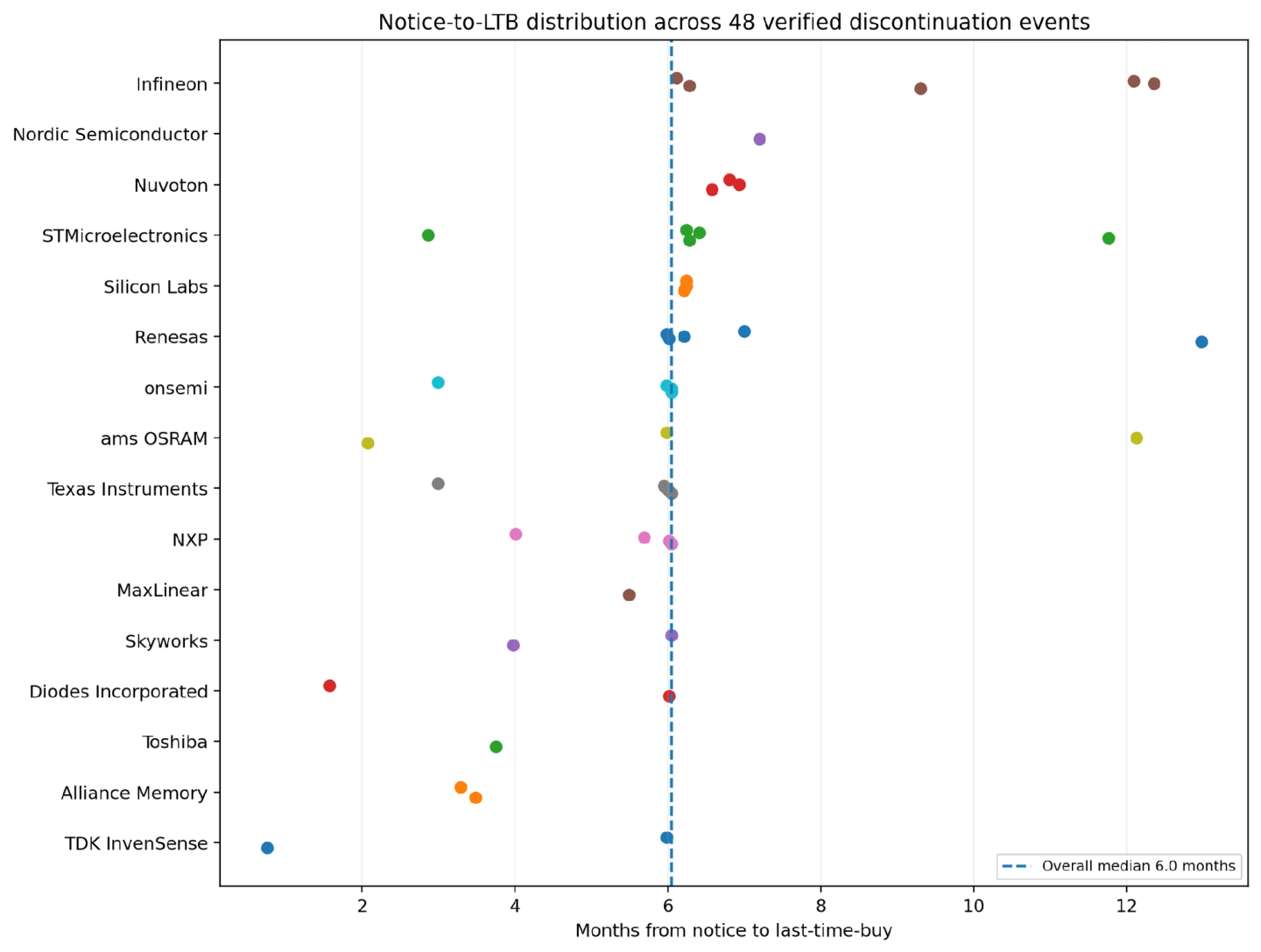
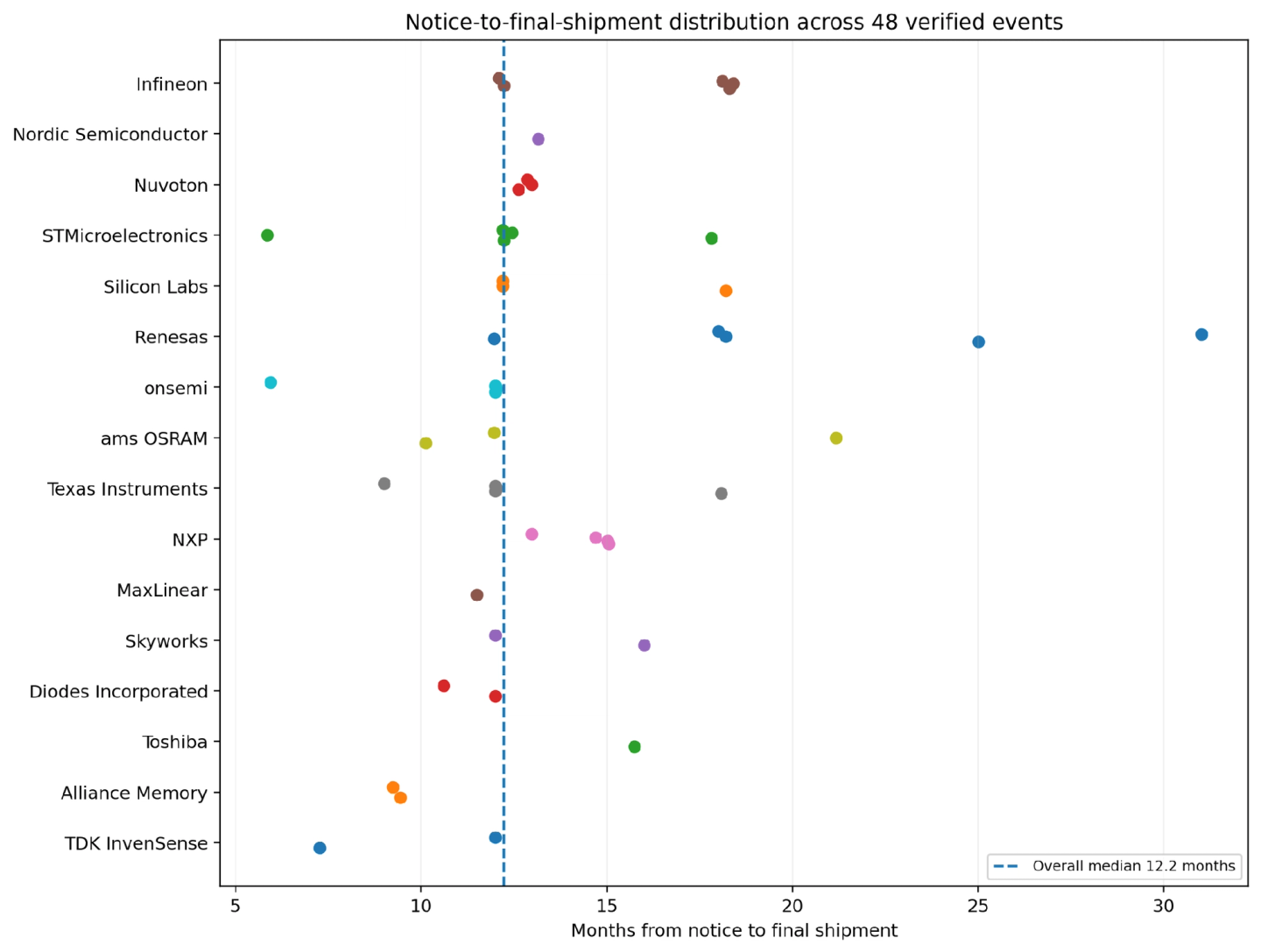
In the audited timing cohort assembled for this report, 48 verified discontinuation events across 16 manufacturers produced a median notice-to-last-time-buy window of 6.0 months and a median notice-to-final-shipment window of 12.2 months. The interquartile ranges were 5.6–6.3 months to Last Time Buy (LTB) and 12.0–15.8 months to final shipment. These are descriptive results from a public-data convenience cohort, not industry-wide population estimates.
The broader research shows that the most important distinction is not simply how many months a component has left. The exit path matters. Some products receive a normal last-time-buy period backed by continued production, while others become inventory-constrained, stock-only, non-manufacturable, or are withdrawn with no practical lifetime-buy opportunity. Treating all of these outcomes as a single continuous “EOL runway” variable hides materially different engineering and procurement risks.
Replacement information is equally heterogeneous. A manufacturer-listed replacement can be explicitly pin-compatible, functionally equivalent but pin-incompatible, an architectural successor requiring hardware and firmware migration, still in development, or merely a reference suggestion that must be qualified by the customer. The report therefore separates replacement availability from replacement readiness and engineering migration burden.
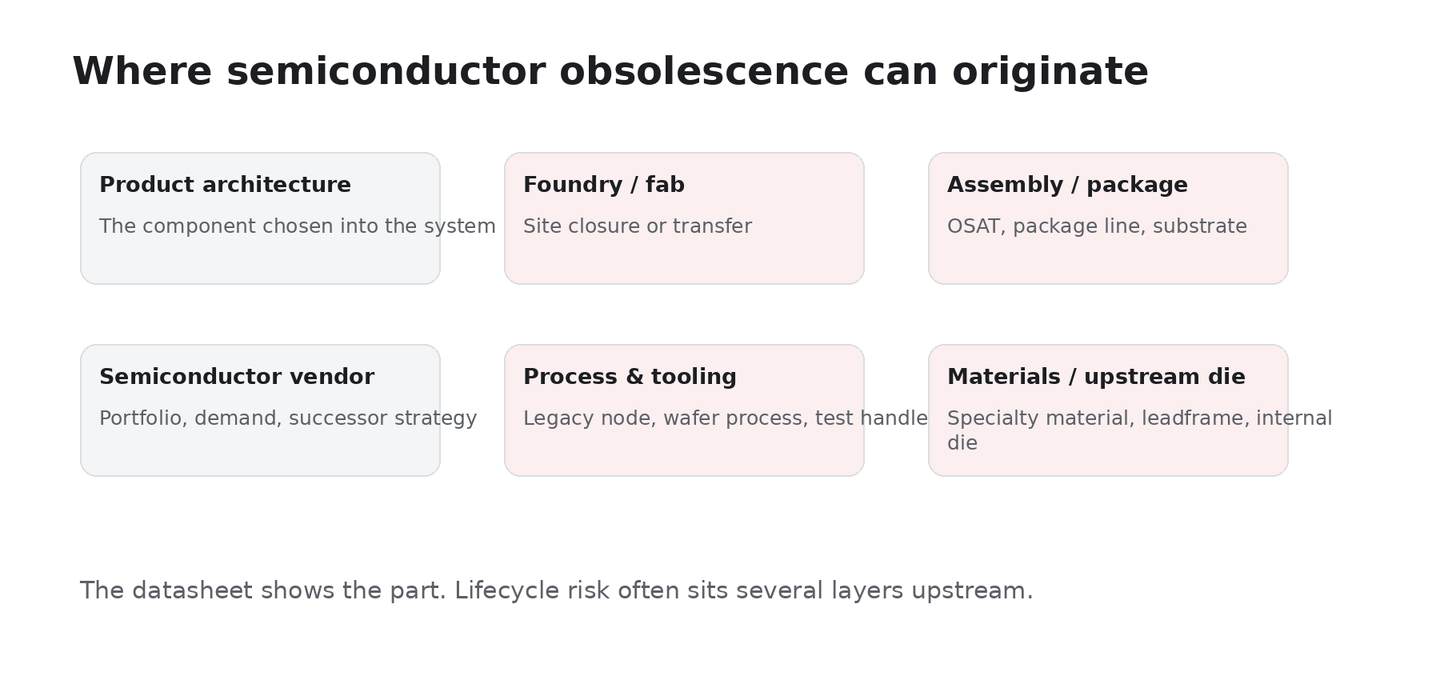
A recurring result across unrelated manufacturers is that semiconductor obsolescence is often driven several layers upstream from the selected part: foundry closures, legacy process technology, aging wafer equipment, test platforms, assembly partners, substrates, specialty materials, regulatory transitions and upstream die suppliers. Component selection is therefore a lifecycle architecture decision rather than a purchasing decision made at the end of development.
Core finding. A ten-year product can still face a six-month component decision. Long-term design risk depends on the availability commitment, exit path, supply certainty, upstream manufacturing exposure and replacement burden.
Research design and methodology
The benchmark uses a primary-source-first protocol. Manufacturer lifecycle pages, longevity programs, official PCN/PDN/PTN archives, product pages and manufacturer-issued discontinuation notices are preferred. JEDEC and IEC are used for standard context. Authorized distributor mirrors are used only when they reproduce an identifiable manufacturer-issued document.
- Manufacturer-level analysis records what lifecycle information is publicly discoverable before a component is selected.
- Event-level analysis records notice date, exit-path classification, last-time-buy, final shipment, primary cause and cause flags.
- Part-level analysis records replacement availability, readiness, compatibility evidence and migration severity when the notice exposes those fields.
- Latest-five discontinuation events are preferred when a manufacturer exposes a complete chronological archive. If fewer than five qualifying events are publicly verifiable, all qualifying events are used. Ties at the chronological cutoff are retained rather than arbitrarily discarded.
- Archive year or page grouping is never used as a proxy for manufacturer notice date. The manufacturer-issued notice date is authoritative.
- Records with apparent date anomalies are not automatically discarded. They are first checked for stock-only, no-LTB or inventory-constrained semantics.
The 48-event timing cohort used in the quantitative charts is an audited convenience cohort assembled only from events for which notice, LTB and final-shipment dates were explicitly verifiable in the public evidence gathered during this study. It should not be interpreted as a random sample of all semiconductor EOLs. Standards context: JEDEC J-STD-048 and IEC 62402.
Three denominators, three different questions
A recurring source of confusion in lifecycle benchmarking is denominator choice. This report keeps manufacturer-weighted, event-weighted and part-weighted analyses separate.
| Unit | Best used for | Example question |
|---|---|---|
| Manufacturer | Transparency and policy | How many manufacturers publish a public EOL archive? |
| Event | Withdrawal process | How often did an observed EOL event offer a standard LTB window? |
| Part | Replacement / redesign exposure | How many affected orderable parts had a listed or pin-compatible replacement? |
The manufacturer landscape
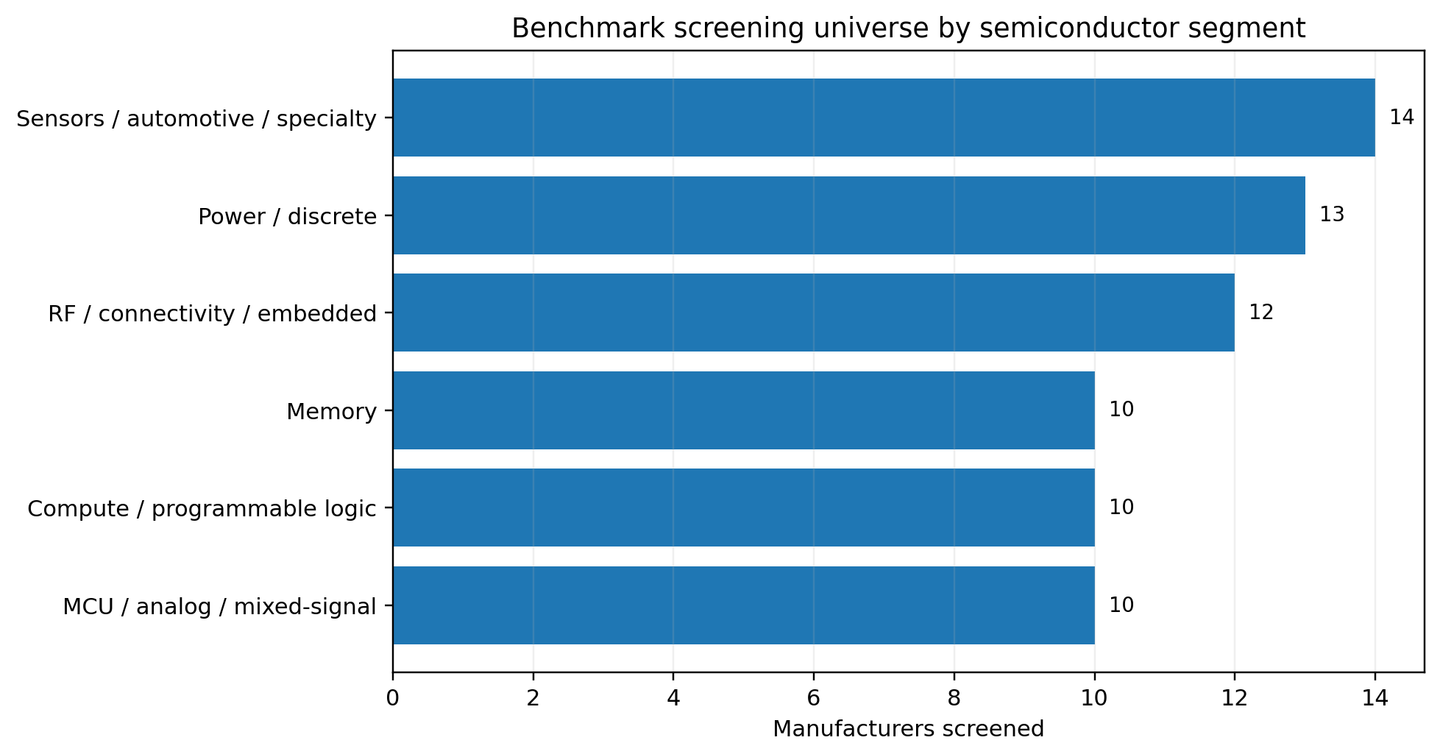
The screening universe spans major integrated device manufacturers, fabless analog and connectivity suppliers, memory vendors, programmable-logic companies, RF specialists and sensor vendors. Inclusion in the screening universe means the manufacturer was evaluated under the same public-source protocol. It does not imply that the same quantitative metrics are available for every company.
Public-data quality varies materially. Some manufacturers expose searchable historical archives with notice dates, LTB, LTS, reason and replacement data. Others publish lifecycle policies but require customer portals for individual notices. A third group exposes product status but no structured public discontinuation history could be located under the documented search protocol.
| Evidence tier | Definition | Use in this report |
|---|---|---|
| A | Public event-level evidence supports at least one quantitative metric | Eligible for event/part analysis where fields are complete |
| B | Public lifecycle or policy evidence is strong, but event-level extraction is incomplete | Policy and transparency analysis |
| C | Manufacturer screened; no sufficiently structured public event evidence located | Transparency result only; no inference about customer-facing private notices |
There is no standard definition of semiconductor longevity
The research found several distinct policy models. The language often sounds comparable at first glance, but the underlying commitment structure differs.
| Manufacturer | Public model | Interpretation |
|---|---|---|
| Texas Instruments | Typical lifecycle + anti-obsolescence conditions | TI states that product lifecycles are typically 10–15 years and often longer, with explicit conditions that protect standard products from obsolescence. |
| NXP | Formal Product Longevity Program | Participating products receive 10- or 15-year minimum periods that can be extended; expiration does not automatically mean discontinuation. |
| STMicroelectronics | Formal 7 / 10 / 15 / 20-year commitments | Covered products are assigned defined longevity commitments by program. |
| Microchip | Continuity-oriented portfolio policy | Microchip emphasizes maintaining older products where reasonably possible and publishes EOL policies and notices. |
| Infineon | Planned availability horizons | Product-specific tables publish availability planned until at least a given date, subject to stated caveats. |
| Renesas | Product-specific PLP | Products in the program receive a published longevity period while participating. |
| Qorvo | Forward availability for selected longevity products | The longevity page publishes launch date and committed availability date for selected products. |
Selected official references: Texas Instruments, NXP, STMicroelectronics, Microchip, Infineon, Renesas and Qorvo.
Interpretation. A “10-year program”, a “typical 10–15-year lifecycle”, and “planned availability until 2030” are different forms of evidence. The benchmark therefore compares policy structure before it compares headline years.
How semiconductor products actually leave the market
The research identified four operationally different exit paths. This distinction is essential because a published LTB date does not always imply continued production or dependable supply.
| Exit path | What it means | Engineering implication |
|---|---|---|
| Standard fixed LTB | A defined final-order date with normal production / fulfillment mechanics | The cleanest basis for timing analysis |
| Capacity constrained | A final-order date exists, but quantities or capacity may be limited | Published runway can overstate practical supply certainty |
| Inventory constrained / stock only | Orders are accepted only while finished goods or existing inventory remains | Date alone is insufficient; inventory depletion can end supply earlier |
| No LTB / non-manufacturable | No conventional lifetime-buy opportunity is offered | Immediate redesign, alternative sourcing or product-level mitigation may be required |
Central Semiconductor provides direct examples of immediate “Stock Only” withdrawal in which orders can only be accepted against inventory already on hand. Analog Devices PDN 25_0093 explicitly describes a discontinuation with no lifetime-buy option, while NXP notices can mark specific products as non-manufacturable when no supply or inventory exists.
The last-time-buy benchmark
Among the 48 verified events in the audited timing cohort, the median notice-to-LTB interval was 6.0 months. The middle 50% of events fell between 5.6 and 6.3 months. The timing distribution is visibly multi-modal: several vendors cluster near six months, while some events are substantially shorter or longer.
The median notice-to-final-shipment interval was 12.2 months, with an interquartile range of 12.0–15.8 months. Final-shipment windows are generally longer than LTB windows, but the practical value of that additional time depends on whether a customer secured enough material before the order window closed.
Vendor-level descriptive medians
| Manufacturer | Events | Median to LTB | Median to final shipment |
|---|---|---|---|
| TDK InvenSense | 2 | 3.4 mo | 9.6 mo |
| Alliance Memory | 2 | 3.4 mo | 9.3 mo |
| Toshiba | 1 | 3.7 mo | 15.7 mo |
| Diodes Incorporated | 2 | 3.8 mo | 11.3 mo |
| Skyworks | 2 | 5.0 mo | 14.0 mo |
| MaxLinear | 1 | 5.5 mo | 11.5 mo |
| NXP | 4 | 5.8 mo | 14.9 mo |
| Texas Instruments | 5 | 6.0 mo | 12.0 mo |
| ams OSRAM | 3 | 6.0 mo | 12.0 mo |
| onsemi | 4 | 6.0 mo | 12.0 mo |
| Renesas | 5 | 6.2 mo | 18.2 mo |
| Silicon Labs | 3 | 6.2 mo | 12.2 mo |
| STMicroelectronics | 5 | 6.3 mo | 12.2 mo |
| Nuvoton | 3 | 6.8 mo | 12.8 mo |
| Nordic Semiconductor | 1 | 7.2 mo | 13.1 mo |
| Infineon | 5 | 9.3 mo | 18.1 mo |
These are medians of the observed events in this research cohort, not manufacturer-wide service-level guarantees and not a ranking.
Why semiconductors become obsolete
The public notices repeatedly show that low demand is only one route to discontinuation. Product availability can be terminated by manufacturing constraints that sit several layers upstream from the customer-visible part number.
| Cause family | Typical mechanism | Verified examples in research |
|---|---|---|
| Demand / portfolio | Low demand, utilization or portfolio rationalization | Alliance Memory, NXP, onsemi and others |
| Process technology | Legacy wafer process or technology reaches EOL | ADI, ST, Infineon, NXP |
| Fab / site closure | Foundry or internal fab closes / is consolidated | NXP, ams OSRAM-linked cases |
| Test infrastructure | Tester or handler becomes unsupported | Skyworks, Silicon Labs, Teledyne e2v |
| Assembly / OSAT | External assembly line or partner ends support | ADI, Renesas |
| Material / supplier | Specialty material, leadframe, substrate or raw material disappears | Nordic, Cirrus Logic, Skyworks |
| Regulatory transition | Materials or variants withdrawn to meet regulatory / sustainability requirements | Nordic, TI |
| Successor generation | Portfolio moves to a newer architecture / package / generation | Infineon, Wolfspeed |
One of the clearest patterns is tooling and test infrastructure. Silicon Labs published an EOL in 2026 after the supplier of the handler used for device testing stopped supporting the equipment. Teledyne e2v has documented EOL caused by termination of test equipment. Skyworks has documented a 20-year product family ending because a supplier was phasing out chip-bump and tester infrastructure while volumes no longer justified the investment required to sustain the family.
Cascaded obsolescence
Obsolescence can propagate between suppliers. Teledyne e2v documented a processor-family EOL linked to an NXP discontinuation that itself followed the termination of silicon production lines at GlobalFoundries. In other downstream cases, storage products were discontinued because Kioxia flash components were being retired. The practical implication is that a semiconductor vendor can inherit lifecycle risk from another semiconductor supplier or foundry.
Design implication. A BOM risk register that stops at the immediate manufacturer misses part of the real dependency graph. High-coupling components deserve upstream manufacturing scrutiny during architecture selection.
Replacement does not mean drop-in
Manufacturer notices use the word replacement with very different meanings. Some vendors explicitly publish pin-to-pin compatibility. Others identify a functional successor but warn that package, pinout or performance may differ. A replacement can also be unavailable at the time the EOL notice is issued.
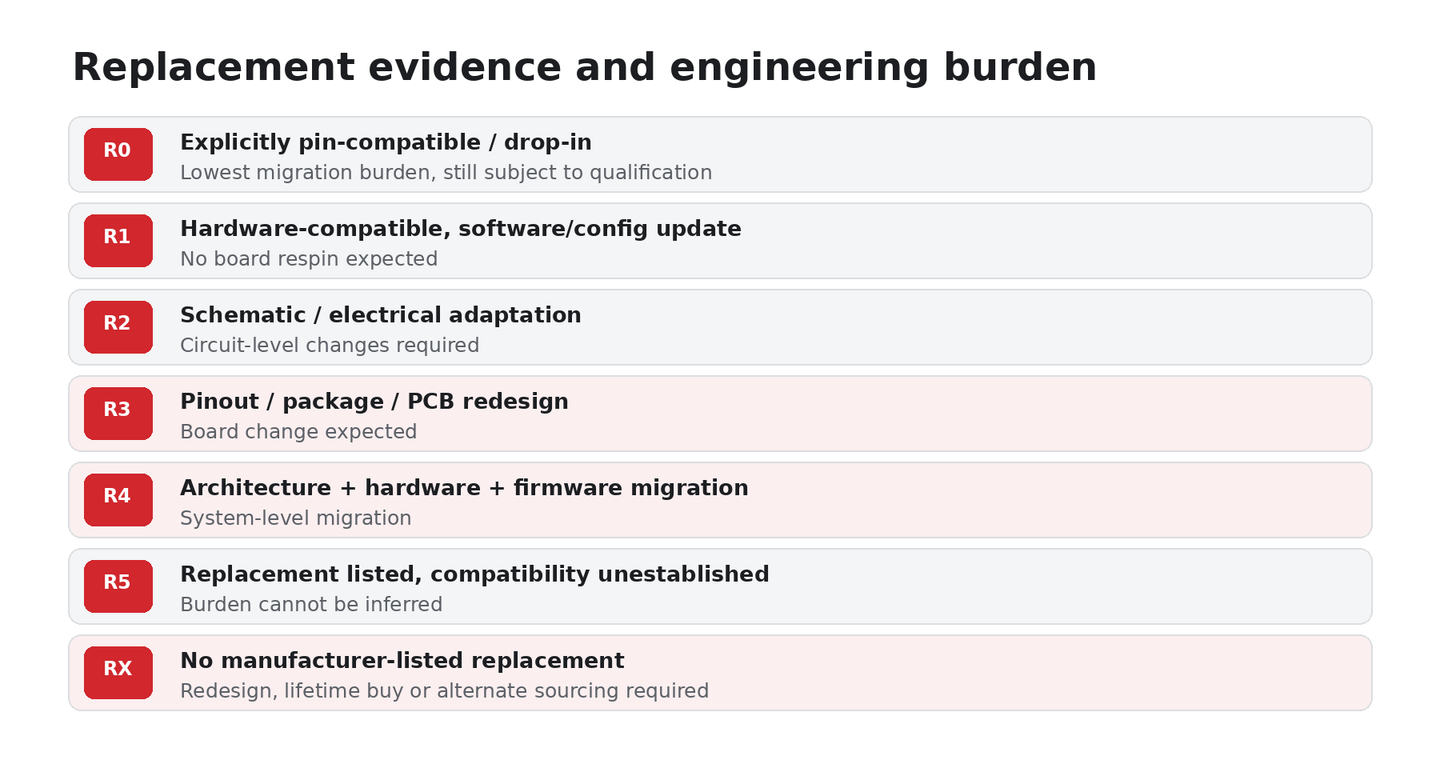
NXP explicitly states that a replacement designation is reference information and does not guarantee the same form, fit, function or performance until the customer qualifies the product. MaxLinear separates “functional equivalent” and “pin compatible” into distinct fields. TDK InvenSense has published an EOL with “No pin-to-pin replacement” and a recommended two-device alternative.
A within-vendor contrast: Analog Devices
Analog Devices provides one of the clearest demonstrations that the cause of EOL can predict migration burden. In package/material-oriented discontinuations, ADI notices often identify pin-compatible replacement variants. In PDN 24_0080, however, a TSMC SRAM process EOL forced migration from ADSP-21065L variants to a newer device, and the notice explicitly states that the suggested replacement requires software and hardware redesign.
This contrast supports a directional hypothesis for future part-level analysis: administrative, packaging and material transitions are more likely to preserve an implementation path than silicon/process obsolescence. The present dataset is not large or normalized enough to publish a universal probability of redesign by cause.
Replacement readiness
Replacement availability and replacement readiness are distinct variables. Alliance Memory’s 2026 LPDDR4X discontinuation identifies alternatives, but the replacement for one density had not yet been released while other alternatives were already in mass production. That makes a simple replacement-coverage percentage potentially misleading.
The benchmark therefore records whether a listed alternative is available, in development, contact-manufacturer, absent or unknown. Ampleon’s discontinued and replacement parts list is one example of a public replacement register.
Lifecycle transparency benchmark
The 69-manufacturer screen shows large differences in what an engineer can verify without a sales relationship or customer portal. The report does not convert this into a weighted score. Instead, transparency should be read as a disclosure matrix.
| Manufacturer | Lifecycle states | Longevity program | Public EOL archive | Historical access | Notice date | LTB | LTS | Reason | Replacement | Compatibility | Forward horizon |
|---|---|---|---|---|---|---|---|---|---|---|---|
| Nuvoton | ✓ | ✓ | ✓ | ✓ | ✓ | ✓ | ✓ | — | ✓ | — | — |
| Nordic Semiconductor | ✓ | — | ✓ | ✓ | ✓ | ✓ | ✓ | ✓ | ✓ | — | — |
| MaxLinear | ✓ | — | ✓ | ✓ | ✓ | ✓ | ✓ | ✓ | ✓ | ✓ | — |
| Qorvo | ✓ | ✓ | ✓ | Partial | ✓ | ✓ | Partial | Partial | ✓ | Partial | ✓ |
| pSemi | ✓ | — | ✓ | ✓ | ✓ | ✓ | ✓ | Partial | ✓ | Partial | — |
| Microchip | ✓ | ✓ | ✓ | ✓ | ✓ | ✓ | ✓ | ✓ | ✓ | Partial | — |
| Analog Devices | ✓ | — | ✓ | ✓ | ✓ | ✓ | ✓ | ✓ | ✓ | ✓ | — |
| Lattice Semiconductor | ✓ | — | ✓ | ✓ | ✓ | Partial | Partial | Partial | ✓ | Partial | — |
This matrix is illustrative of the disclosure dimensions used across the full screening universe. “Partial” means the field exists for some products or notices but is not consistently available in a public structured source.
Nuvoton is a particularly clean example: its public EOL page exposes notification date, last order, last shipment and recommended replacement in a structured table. Nordic exposes a chronological PDN index. MaxLinear’s notices can distinguish functional equivalence from pin compatibility. Qorvo combines lifecycle status with a separate forward-looking longevity program.
The Detus Lifecycle Assurance Framework
The research does not justify collapsing lifecycle exposure into an arbitrary 0–100 score. The framework keeps five engineering dimensions visible so that a design team can see what type of risk is being accepted.
| Dimension | Engineering question | Why it matters |
|---|---|---|
| A · Availability horizon | What formal longevity commitment, planned-availability horizon or product status is publicly documented? | Separates headline longevity language from the evidence that actually exists. |
| E · Exit-path risk | If the part is withdrawn, is the path standard LTB, capacity-constrained, inventory-only or no-LTB? | Distinguishes a dependable planning window from a date that can disappear with inventory. |
| S · Supply-chain exposure | Which foundry, fab, process, test, assembly, package, material or upstream supplier dependencies matter? | Makes hidden upstream dependencies visible before they become emergency redesigns. |
| R · Replacement burden | Is the alternative R0, R1, R2, R3, R4, R5 or RX, and how strong is the compatibility evidence? | Prevents a listed replacement from being mistaken for a drop-in solution. |
| U · Update / qualification impact | What firmware, PCB, EMC, safety, compliance, validation and production-documentation work would the migration trigger? | Captures the downstream work that often dominates the true cost of obsolescence. |
Engineering playbook for ten-year products
- Select high-coupling components with lifecycle architecture in mind. MCUs, processors, PMICs, memory, RF devices and sensors can create firmware, board and qualification work disproportionate to their BOM value.
- Capture the manufacturer’s lifecycle model in the design record. Record whether the evidence is a formal minimum commitment, planned availability, a portfolio policy or merely the current lifecycle status.
- Subscribe to the manufacturer’s PCN/PDN service before design freeze and assign ownership for lifecycle monitoring.
- For critical parts, document the exit-path assumption. A six-month production-backed LTB and a twelve-month inventory-constrained LTB are not equivalent.
- Record replacement evidence at selection time. Prefer parts and vendors that expose package, pin and compatibility information when possible.
- Map upstream manufacturing dependencies for sole-source or hard-to-migrate parts. Mature process nodes, unique test platforms, specialist packages and external assembly partners deserve attention.
- Design migration boundaries into the product. Clean hardware abstraction, reproducible firmware builds, controlled interfaces and modular power/RF subsystems reduce future redesign scope.
- Review lifecycle exposure at major gates: architecture freeze, EVT/DVT, certification, production release and recurring annual sustaining-engineering reviews.
Detus tip. The cheapest lifecycle redesign is the one considered before the PCB, firmware architecture and certification plan are frozen.
Conclusion
The benchmark changes the way component longevity should be framed. Availability is only the first layer. Once a product begins to exit the market, the engineering consequences depend on the exit path, the reliability of the remaining supply, the upstream reason for discontinuation and the migration burden of the replacement.
For long-lived electronic products, a component with a credible forward availability commitment, a transparent discontinuation process and a documented migration path can be materially safer than a nominally similar component whose lifecycle information is opaque. The decision belongs in architecture, not only in procurement.